
Narrow Panels, Older Retainer Track
A door built in the mid-60s uses a narrower panel section and an older style of retainer track than anything installed after 1980, and it's usually the retainer track, not the panel steel itself, that fails first.
Golden Valley, Minneapolis
Golden Valley homes mostly date to 1966, older than the metro median. That means narrower panel sections and retainer tracks a 2005 door doesn't have. Panel replacement done right.
Symptoms
Golden Valley's housing stock centers on 1966, nearly a decade ahead of the 1975 median across the wider service area. That gap matters more than it sounds like it should.
A door built in the mid-60s uses a narrower panel section and an older style of retainer track than anything installed after 1980, and it's usually the retainer track, not the panel steel itself, that fails first.
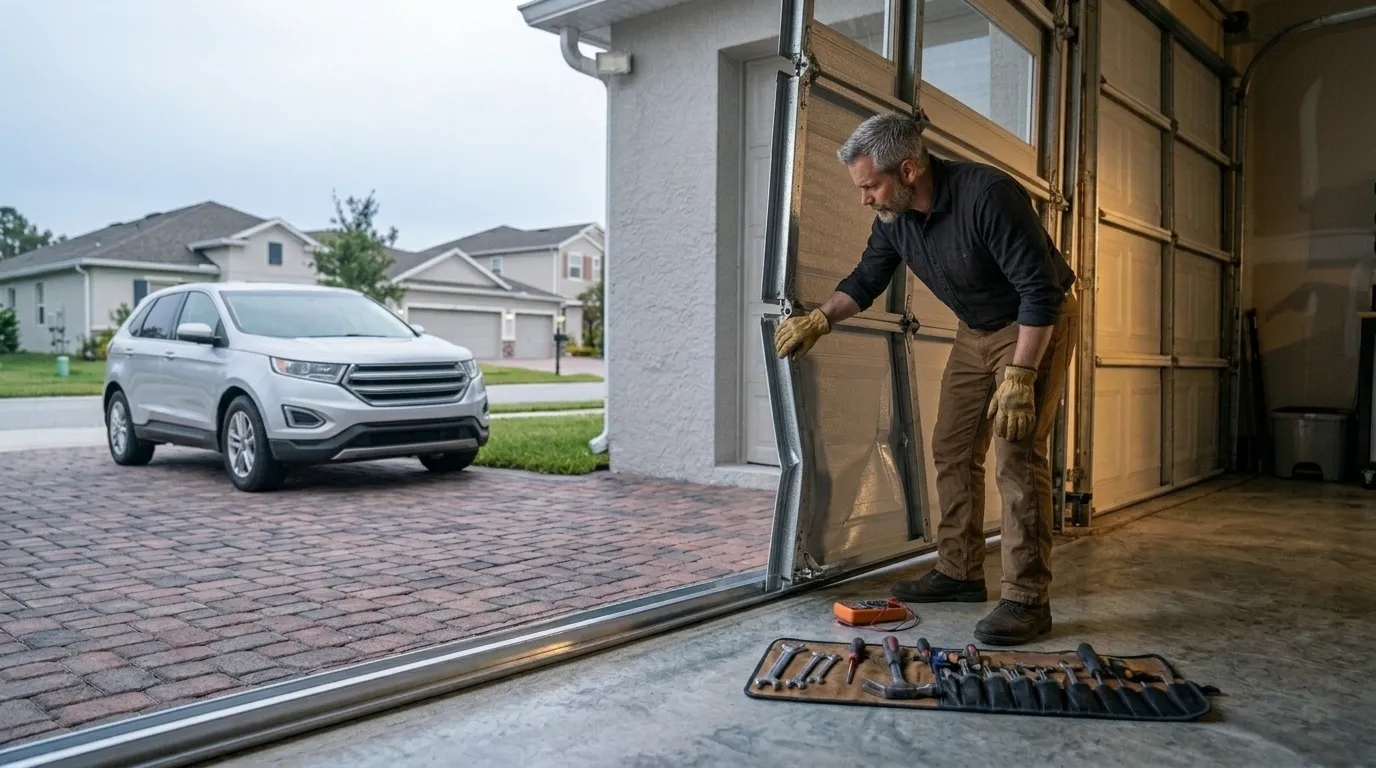
You'll see a dent low on the door where a bumper clipped it, or a crease across a middle panel where the door got forced down on something. Sometimes it's simpler: the bottom panel has rusted through at the weatherstrip channel because that's where water sits longest.
On a house this age, the fix isn't always "order a panel and swap it." The section width and the hinge spacing on a 1966 door often don't match what a big-box store stocks off the shelf, which changes how the job gets quoted before it changes how it gets done.
Booking
We work out of Minneapolis and Golden Valley sits about five miles out, which keeps the truck ride short and doesn't add freight time to the quote the way a farther-out job might. Before we book anything, we want to know the door's age, whether it's a single wide door or two singles, and whether the track is torsion or extension. On a door from the 1966 build era, we also ask about the panel profile - long or short panel, and whether the retainer clips are the older stamped-metal style. That's usually enough over the phone to tell you whether we're bringing a matching panel section or whether the honest answer is that full-door replacement will cost less than chasing a discontinued profile.
Watch-outs
The service area sits in a cold, severe winter climate, and that's harder on an older panel than most owners expect.
Steel that's already thin from age flexes more in a hard freeze, and a crack that started as a hairline in October can be a foot long by February.
On a mid-1960s door, we also see panel seams that have separated at the hinge line - the fasteners are original, and fifty-plus winters of expansion and contraction work them loose.
If the door has taken an impact, the bigger risk isn't the dent, it's whether the section still sits flush enough for the rollers to track straight.
A panel that's out of true puts uneven load on the springs and the opener, and that's a second repair bill waiting to happen if it's ignored.
The repair
Golden Valley's median household income runs at $114,435, well above the $96,224 median across the wider service area, and that shows up in what owners here tend to choose - and in how the job gets quoted.
More often than not, it's a matching insulated panel rather than the cheapest available steel - worth mentioning since insulated sections cost more and take a little longer to source.
If your door still uses the older panel profile common to 1960s builds, we measure the section width and hinge spacing on site before ordering, because a mismatch means the door won't seal evenly against a cold-climate winter.
Straightforward single-panel swaps on a door that's still square usually run a few hours.
If the impact bent the track or knocked the roller out of alignment too, that adds time - we won't quote it as a quick panel swap if it isn't one.

On the truck
We carry common steel panel sections in standard widths, along with the hardware that goes with them - hinges, roller brackets, and retainer clips in current profiles. What we don't carry is a stock of discontinued panel styles specific to 1960s-era doors; those get special-ordered once we've confirmed the exact section width and profile on site, and that's the honest limitation here - if your door needs an obsolete panel, there's a wait on the part, not on the labor. For a full-door swap instead of a single panel, we bring insulated and non-insulated options built for a cold climate, since a single-skin panel is a poor match for a Minnesota winter no matter how clean the color match looks.
Questions
Not usually, but a door built around 1966 often uses an older panel profile and hinge spacing than newer stock doors. We measure on site to confirm the section width before ordering. Sometimes a matching panel is available; sometimes full-door replacement ends up cheaper than a special-order match, and we'll tell you which applies before you commit.
Yes. The service area sits in a cold, severe-winter climate zone, and a single-skin steel panel performs worse than an insulated one over a Minnesota winter. If you're replacing more than one section, it's worth asking about insulated options even if the rest of the door isn't insulated yet.
About five miles, so travel time doesn't add much to scheduling. We work from Minneapolis and cover Golden Valley as part of the wider service area without a local branch or depot here.
If the section is a single panel out of a multi-panel door and the steel hasn't cracked, replacing just that section is usually the cheaper route. If the impact knocked the track or hinge line out of alignment too, that gets assessed separately before we quote the job.
Explore more


Ready when you are
Minneapolis Garage Door Pros repairs and installs garage doors, springs and openers in Minneapolis, MN and the surrounding area.